
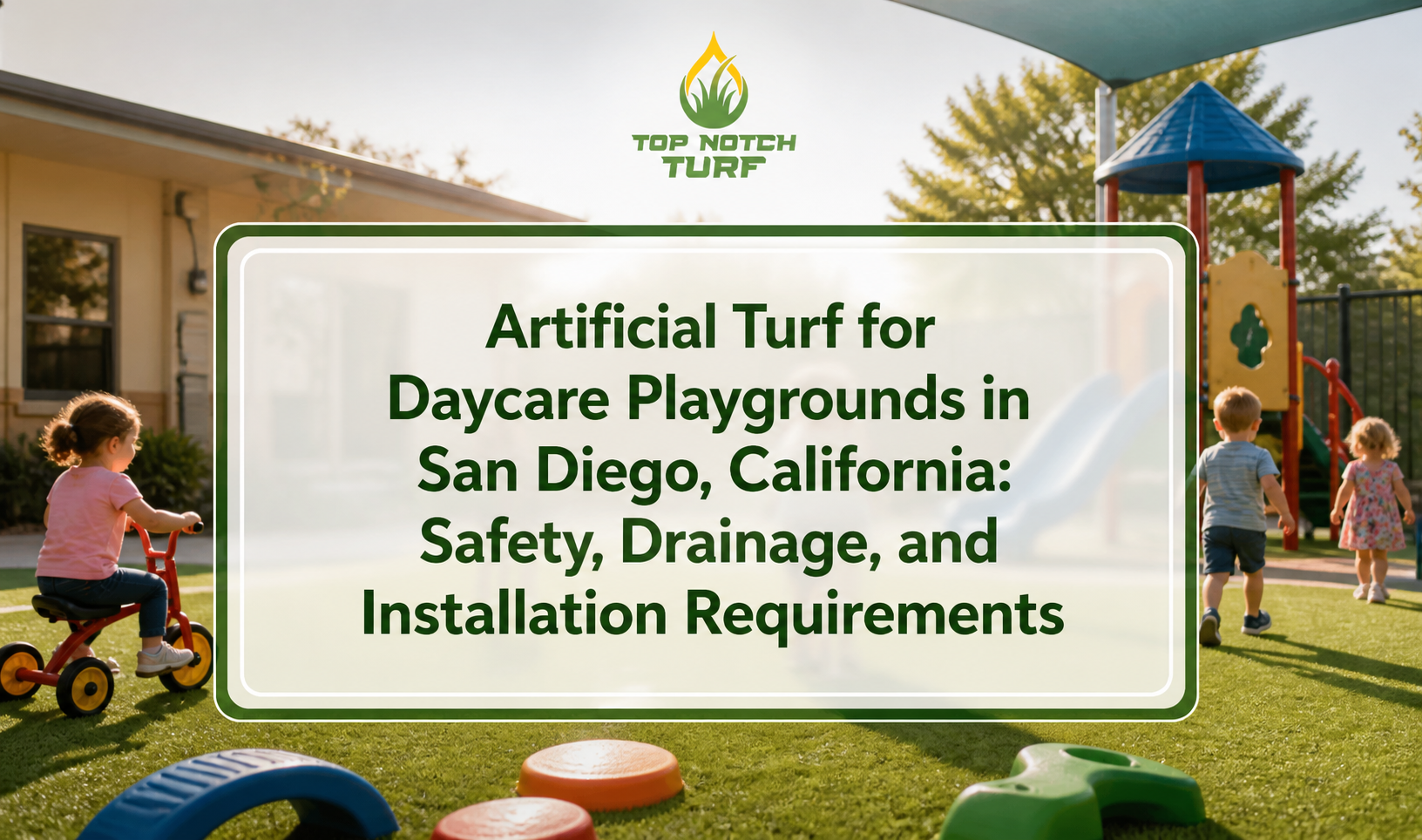
Artificial Turf for Daycare Playgrounds in San Diego, California: Safety, Drainage, and Installation Requirements
Key Takeaways
Artificial turf for daycare playgrounds San Diego projects perform best when they are treated as a safety surface system, with a properly graded and compacted base, a clear drainage discharge path, and reinforced seams and edges in high-traffic areas. Impact protection in fall zones typically depends on the full turf-plus-pad assembly and should be documented and planned around equipment layout and daily cleaning needs.
- Drainage is a full-profile plan: Prevent standing water by building consistent slope, using a permeable, well-compacted base, and confirming where storm and wash-down water will discharge rather than relying on “perforated turf” alone.
- Impact attenuation requires system documentation: Cushioning under and around equipment commonly comes from a shock pad, and performance depends on thickness, density, seams, and permeability—so request product data and any available system performance documentation for the specific turf-plus-pad assembly.
- Seams, edges, and gates are the common weak points: Most visible problems (lifting edges, separating seams, wrinkles, and low spots) trace back to site prep and installation details, so seams should be planned away from main play paths and edges mechanically restrained and reinforced at entries and transitions.
Artificial turf for daycare playgrounds San Diego projects must be planned around child safety, reliable drainage, and compliant installation details for frequent daily use. A properly specified system focuses on impact attenuation under and around play equipment, secure seam and edge construction, and surfacing that stays stable during running, crawling, and rolling.
In San Diego’s coastal and inland microclimates, playground turf has to manage irrigation overspray, occasional heavy rain, and high UV exposure without creating standing water or premature wear. Key technical decisions typically include the base profile and compaction, drainage layers and outlet routing, antimicrobial and infill choices appropriate for young children, and maintenance practices that keep the surface even and hygienic.
This introduction outlines the core safety and drainage considerations and the installation requirements to discuss with your installer, including sub-base preparation, shock pad selection, fall-zone planning, and documentation to keep on file for inspections and ongoing care.
Safety-first system design for daycare playground turf
A daycare playground surface has to do more than look green—it needs a build-up that supports predictable footing, reduces injury risk in play zones, and holds up to daily traffic, cleaning, and equipment movement.
When planning artificial turf for daycare playgrounds San Diego projects, it helps to think in “layers” and “zones.” The layers (subgrade, base, drainage components, optional shock pad, turf, infill) determine drainage and stability, while the zones (under equipment, circulation paths, quiet play areas, gates/entries) determine where extra protection and reinforcement are needed.
- Layer performance: A stable base and consistent compaction help prevent dips that can become trip hazards or collect water.
- Zone performance: Fall zones and high-traffic corridors often need additional cushioning, stronger seaming, and more frequent grooming/cleaning.
- Documentation: Keep records of what was installed (product specs, layout, drainage plan, and maintenance plan) so staff can answer inspection questions and schedule upkeep.
Drainage planning for San Diego sites (coastal fog, inland heat, and heavy rain events)
Good drainage comes from the full profile—subgrade slope, base materials, and outlet routing—not just “perforated turf.” Your installer should confirm how water will leave the site during storms and during routine wash-downs.
Even though San Diego is relatively dry, playground turf still has to handle irrigation overspray, hose cleaning, and occasional intense rain. Coastal areas may see frequent morning moisture, while inland sites often deal with dusty conditions that can clog surface pores if maintenance is neglected. Drainage design should anticipate both water flow and fines (dirt) migration.
Subgrade and base slope: preventing standing water before it starts
A consistent slope is the most reliable “drainage feature” you can build—because it works even if infill shifts or pores clog over time.
Ask for a plan that shows slope direction and discharge points before excavation starts. In tight daycare footprints (especially between buildings and fences), water can get trapped unless the base is shaped to shed it to a drain line or suitable perimeter outlet.
- Confirm where water exits the play area (yard drain, area drain, perimeter trench drain, or approved discharge point).
- Ask how transitions are handled at gates, sidewalks, and door thresholds to reduce pooling.
- Ensure any drain inlets are protected so they don’t become debris traps from leaves, bark, or toys.
Base materials and compaction: stability and permeability working together
The base must be both firm (to prevent ruts) and permeable (to move water through), which depends on correct aggregate selection and compaction practices.
For daycare use, unevenness is more than cosmetic—small depressions can turn into tripping points during running and group play. A well-built base uses appropriate aggregate gradation for drainage and is compacted in lifts so it doesn’t settle later. If your site has expansive clay or localized low spots, it may require additional stabilization or deeper excavation to achieve a durable result.
- Excavation to design depth: Remove organics and loose material that can decompose and cause settlement.
- Subgrade proofing: Identify soft spots and correct them before aggregate placement.
- Aggregate base placement: Install in layers to achieve consistent density and grade.
- Final grading: Check elevations, slope, and smoothness prior to turf.
Drainage layers, geotextiles, and outlet routing
Drainage components should be chosen based on soil type, surrounding hardscape, and how the site will be cleaned—not as a one-size-fits-all upgrade.
Some projects benefit from a geotextile separation layer that helps keep native soil from migrating into the base. On sites with known slow-draining soils, a perimeter or interior drain system may be appropriate, but the most important piece is confirming where it leads and how it will be maintained.
- Geotextile fabric (when appropriate): Can help separate soil and base to reduce contamination and long-term clogging.
- Perimeter collection: Useful when the play area is boxed in by concrete or buildings and needs a defined exit path.
- Clean-out access: If a drain line is installed, ask where clean-outs are located for future flushing.
If you want a deeper explanation of the mechanics behind common systems, see how artificial turf drainage works in San Diego.
Impact attenuation and fall-zone planning around play equipment
Impact attenuation is one of the most important variables for daycare playground safety, and it’s heavily influenced by equipment height, intended age group, and the complete surfacing system (not turf alone).
Daycare playgrounds commonly include climbers, slides, and stepping features where falls are foreseeable. While turf provides traction and a soft feel, the protective performance typically comes from an underlying cushion layer (often a shock pad) and the way it is integrated across fall zones.
Shock pad selection: what to clarify with your installer
Shock pads can improve cushioning and consistency, but performance depends on thickness, density, seams, and how the pad is installed over the base.
Different pads behave differently under heat, repeated compression, and heavy play equipment. If your project requires validated impact performance, request documentation for the specific turf-plus-pad system you are installing and confirm the testing relates to the full assembly (not just one component).
- Thickness and density: Must align with the equipment layout and intended safety goals.
- Seam treatment: Poorly joined pad seams can telegraph through turf and create ridges.
- Moisture behavior: Confirm whether the pad is permeable and how it drains under wash-down.
- Repairability: Ask what happens if a section is damaged—can it be replaced without redoing the entire surface?
Fall zones and transitions: avoiding weak points
Most surfacing failures and trip hazards show up at transitions—where turf meets concrete, curbs, ramps, or loose-fill areas.
A safe layout considers how children run from one activity to another. For example, exits from slides and swings tend to be high-energy “landing zones” where surface flatness and cushioning matter most. Edges should be secured so they can’t be lifted by traffic, toys, or cleaning tools.
- Map play equipment footprints and expected circulation routes.
- Identify fall zones and any areas that need added cushioning or reinforcement.
- Detail edges at hardscape with secure terminations (nailer boards, concrete curbs, or approved edging systems).
- Plan for accessible routes if required by your facility design, including smooth transitions at gates and ramps.
Choosing child-appropriate turf materials: fibers, infill, and antimicrobial options
Material choices affect heat, cleanliness, and long-term appearance—so daycare projects benefit from selecting products with maintenance and hygiene in mind, not only softness.
For young children, you’ll want turf that stays stable under frequent pivoting and kneeling, and that doesn’t shed excessively. You’ll also want to clarify how the surface will be cleaned (rinse, disinfect, enzymatic cleaners) and ensure the selected infill and backing are compatible with those practices.
Fiber and face weight considerations for heavy daily use
Durability is influenced by fiber shape, resilience, and how densely the turf is manufactured, but the “best” option depends on how the space is used.
Daycare environments often create concentrated wear near gates, around popular play structures, and along teacher supervision paths. In those areas, a more wear-resistant product and thoughtful layout (including potential reinforcement under frequent turning points) can help reduce matting.
- Resilient blade design: Can help fibers rebound after compression from running and rolling.
- Dense construction: Often improves stability and appearance retention.
- Thatch layer: Can help support fibers and improve a natural look, but still needs grooming.
Infill options: performance, cleanliness, and heat trade-offs
Infill affects traction, fiber support, drainage behavior, and surface temperature—so it should be chosen with realistic expectations about maintenance and San Diego weather.
Some daycare operators prefer low-tracking infill to reduce migration into classrooms, while others prioritize cooling and softness. No infill is “maintenance-free,” and all systems can collect dust over time, especially in inland areas with wind and dry conditions.
- Sand-based infill: Common for stability; may track if not managed at entries.
- Alternative infills: May reduce heat or tracking depending on formulation, but should be vetted for compatibility with cleaning agents and the drainage design.
- Infill depth management: Too little can lead to faster wear; too much can feel loose and increase tracking.
Antimicrobial treatments and cleaning compatibility
Antimicrobial features can be part of a hygiene plan, but they do not replace routine cleaning, rinsing, and spot disinfection protocols.
Daycare staff should have a clear, written care plan that includes what products can be used on the turf system without damaging fibers, backing, seams, or pad layers. Also clarify how bodily-fluid incidents will be handled, including rinse volume and where that water goes.
Installation details that protect seams, edges, and high-traffic areas
Most visible turf problems in playgrounds—lifting edges, separating seams, wrinkles, and low spots—trace back to installation details and site prep rather than the turf brand.
Because daycares see daily turning, dragging toys, and frequent cleaning, seam strength and edge restraint matter as much as drainage. A well-installed system should lie flat, remain consistently supported, and resist shifting at perimeters.
Seaming and layout planning
Seams should be planned to avoid primary play paths and to keep directional pile consistent for a uniform look and feel.
Ask where seams will fall on the plan before the rolls are cut. Strategic layout can reduce seam count in high-use zones and keep seams away from slide exits or circulation corridors.
- Minimize seams in fall zones and at equipment exits.
- Confirm seam method and cure time expectations.
- Ensure seams are flat and well-supported to reduce edge telegraphing.
Edges, terminations, and trip-hazard prevention
Secure edges are essential in daycare settings because curious hands, rolling toys, and cleaning equipment can catch loose terminations.
Common edge approaches include attachment to a nailer board, termination under a curb cap, or fastening to an approved edging system. The right choice depends on whether the perimeter is soil, concrete, pavers, or a mix.
- Hardscape edges: Ensure smooth transitions without lips.
- Soil or planter edges: Prevent soil migration onto turf with edging and good landscaping borders.
- Gate entries: Reinforce and flatten thresholds where traffic is concentrated.
Reference table: what to verify before approving a daycare playground turf install
This checklist-style table focuses on verifiable items you can request from your installer and keep on file for staff and inspections.
| Verification Item | What to Request / Confirm | San Diego Site Considerations |
|---|---|---|
| Drainage exit plan | A simple drawing showing slope direction, drain locations (if any), and where water discharges | Account for irrigation overspray, hose cleaning, and intense storm events; avoid routing water toward building slabs |
| Base compaction and flatness checks | Confirmation of lift placement, compaction method, and final grade verification prior to turf | Inland dust and coastal moisture can both affect long-term permeability; a clean, well-graded base reduces future unevenness |
| Shock pad and turf system documentation | Product data sheets and any available system performance documentation relevant to playground impact needs | If equipment changes later (height/layout), impact performance may change; keep records for future planning |
| Seam and edge details | Seam layout plan, edge termination method, and reinforcement at gates/entries | High daily traffic and frequent cleaning increase the importance of robust terminations and avoiding seam placement in main play paths |
| Maintenance and cleaning plan | Written schedule for grooming, rinsing, spot cleaning, and periodic infill leveling/top-up | UV exposure and fine dust can accelerate matting; regular grooming helps maintain footing and drainage performance |
Maintenance routines that keep daycare turf safe, even, and hygienic
Daycare turf maintenance is less about “mowing replacement” and more about keeping the surface level, clean, and consistent for active play every day.
Routine care reduces odors, helps drainage remain effective, and prevents small issues (like low infill or a lifting edge) from becoming safety hazards. Your plan should match your actual usage: number of children, time outdoors, presence of snacks/meals outside, and nearby trees or planter beds.
Daily and weekly essentials for staff
Simple, repeatable tasks are the most effective way to keep a playground surface safe between professional service visits.
- Daily walkthrough: Look for lifted edges, exposed seams, debris, and any developing low spots.
- Debris removal: Remove leaves, sticks, and litter before they break down into fines.
- Spot rinse as needed: Especially under drinking fountains, near gates, and after messy play.
- Entry management: Use walk-off mats and encourage shoe cleaning to reduce tracked-in dust and sand.
Monthly and quarterly maintenance: grooming and infill leveling
Periodic grooming helps fibers stand up and keeps infill distributed, which supports traction and reduces unevenness.
How often you need this depends on use intensity and how windy/dusty your microclimate is. If you notice “shiny” flattened lanes or uneven footing, it’s usually a sign grooming frequency needs to increase.
- Brush/groom in multiple directions to lift pile and redistribute infill.
- Inspect and correct developing depressions before they expand.
- Check edges and transitions at concrete for early separation or gaps.
- Verify drainage performance by observing post-rinse and post-rain dry-down behavior.
Common pitfalls to avoid in daycare playground turf projects
Most problems are preventable when you treat a daycare playground like a safety surface system—not a simple landscaping upgrade.
Knowing the usual failure points helps you ask better questions during bids and walkthroughs. It also helps you compare proposals that may look similar on paper but differ significantly in long-term durability.
- Skipping base corrections: Installing over soft or poorly graded subgrade can lead to settlement and trip hazards.
- Unclear drainage discharge: “It drains through” is not enough—water must have a path to leave the area.
- Weak edges at gates: High traffic concentrates at entries; without reinforcement, edges may lift or curl.
- Overreliance on antimicrobial claims: Hygiene still depends on cleaning routines and compatible products.
- Ignoring heat management: Surface temperatures vary by sun exposure; plan shade, scheduling, and rinse practices accordingly.
Planning your next steps: scope, specs, and the right installer conversation
The best way to protect your budget and your play space is to define the scope clearly: where impact protection is needed, how water will exit, and what maintenance looks like for your staff.
Before you approve an install, ask for a site walk, a simple plan view showing seams and drainage intent, and a maintenance outline tailored to your daycare’s daily routines. If you’re comparing providers, it’s also reasonable to ask how they handle repairs if settlement, seam issues, or edge lifting appears after heavy use.
- Document your zones: fall zones, circulation lanes, quiet corners, and entry chokepoints.
- Request a written build-up: subgrade prep, base thickness, drainage approach, pad (if used), turf type, and infill plan.
- Confirm surface care: what tools and cleaners are recommended and what to avoid.
- Plan for future changes: adding or moving equipment may require surfacing adjustments.
For an overview of installation methods and what a dedicated play-area build typically includes, explore playground turf services.
If you’d like more context about family-focused safety considerations, see whether artificial turf is safe for dogs and kids. For general background on synthetic surfaces and terminology, you can also review artificial turf.
Frequently Asked Questions
Get a daycare playground turf plan that’s built for safety, drainage, and daily use
If you’re evaluating artificial turf for a daycare playground in San Diego, a quick conversation can help you confirm the details that matter most: where water will discharge during storms and wash-downs, how the base will be graded and compacted, and how seams, edges, and high-traffic gates will be reinforced. Clarifying these items early helps you compare proposals on more than just turf style and prevents avoidable rework later.
Top Notch Turf can review your site conditions and priorities so you can request the right build-up, documentation, and maintenance plan for inspections and ongoing care.
Related Posts

Putting Green Turf Maintenance Tips for San Diego, California: Expert Care for Heat, Watering, and Drainage
Key Takeaways Putting green turf maintenance tips San Diego properties can rely on come down…
Comprehensive Guide to Artificial Grass Installation for Sloped Yards in San Diego, California
Key Takeaways Artificial grass installation for sloped yards San Diego lasts when the hillside is…

Expert Guide to Backyard Turf Landscaping Ideas in San Diego, California
Executive Summary Backyard turf landscaping ideas San Diego work best when the design is built…