
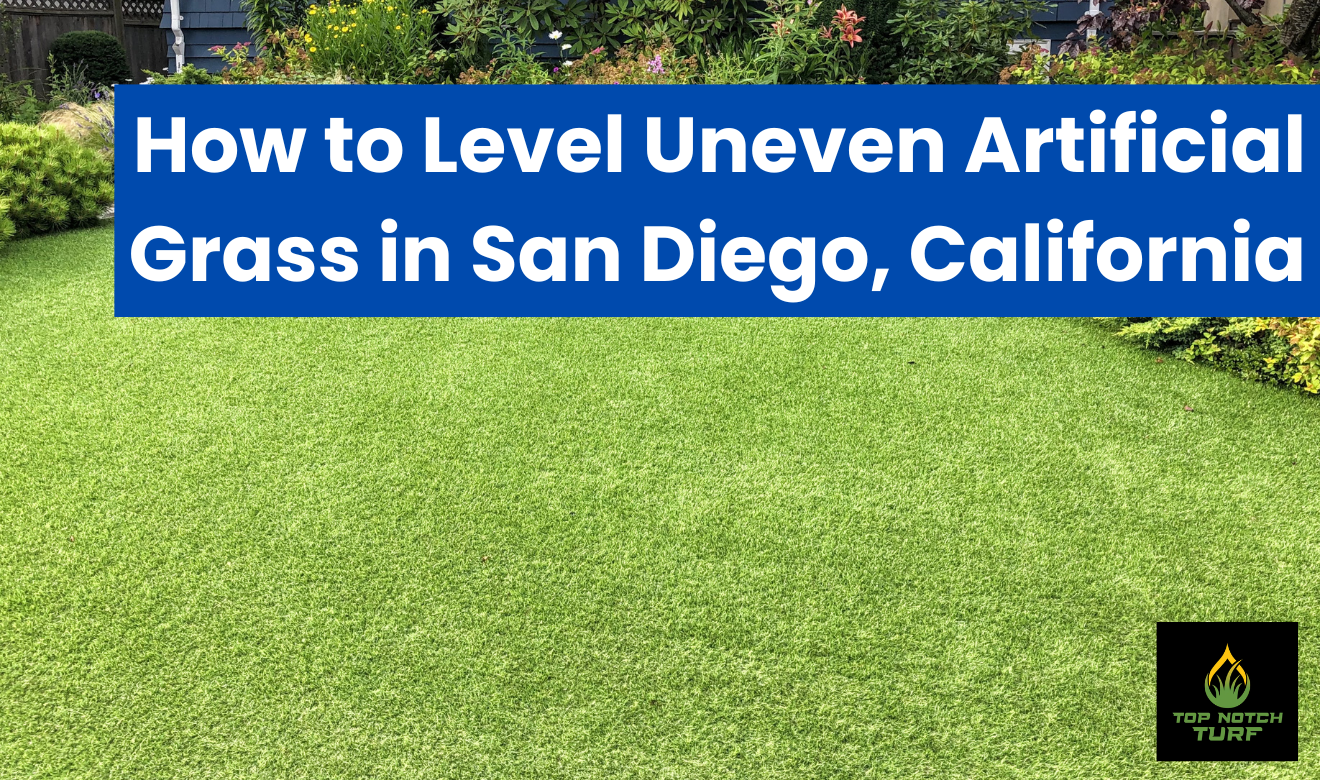
How to Level Uneven Artificial Grass in San Diego, California
Executive Summary
Uneven artificial grass in San Diego is almost always caused by base movement, softening, or poor compaction—not the turf itself. The most reliable fix is to lift only the affected section, re-level and compact the aggregate base, then re-secure seams/edges and restore infill to match the surrounding area.
Key Takeaways
- Base movement is the real problem: Low spots, humps, and seam ridges typically result from shifted or softened base material rather than turf failure.
- San Diego-specific triggers are water and runoff: Winter storms, hillside runoff, and irrigation overspray commonly wash out or saturate edges, leading to settling and puddling.
- Small-area repairs follow a proven process: Remove infill, unfasten and lift the turf, add/remove DG or class II road base, compact thoroughly, then re-lay and re-infill for a seamless blend.
- Seams and edges become trip hazards when bonds/fasteners fail: Flattening a raised seam usually requires removing infill, correcting the base under the seam, re-taping/gluing, weighting flat during cure, and re-nailing as needed.
- Prevention depends on drainage and maintenance: Redirect runoff, eliminate overspray, maintain edging, and keep infill topped up in high-traffic or pet areas to reduce repeat settling.
If you’re wondering how to fix uneven artificial grass San Diego, the direct answer is this: locate the low or high spots, lift the turf, re-level the base with compacted decomposed granite or class II road base, and then re-secure and re-infill the area. In San Diego, this often happens after heavy winter rains, hillside runoff, or irrigation overspray that softens the base. For example, if you notice a “dip” where water puddles near a patio edge, you’ll typically need to add and compact more base material before laying the turf back down. If you feel a raised ridge along a seam that you can trip on, you may need to remove some base, re-compact, and re-pin the seam flat. These fixes are usually small-area repairs, but doing them quickly helps prevent bigger wrinkles, sinking, and drainage problems later.
What causes uneven artificial grass in San Diego?
Before you decide how to fix uneven artificial grass San Diego, you need to know what caused the change. In most cases, the turf didn’t “fail”—the base underneath shifted, softened, or was never compacted evenly.
Most common local causes
- Heavy rain + runoff: San Diego’s winter storms can push water across hardscapes and down slopes, washing out edges and loosening base material.
- Irrigation overspray: Constant water at the perimeter (sprinklers hitting turf seams, planters, or edges) can soften and migrate base over time.
- Improper base compaction: If the base wasn’t compacted in lifts, it can settle later—especially in high-traffic zones.
- Expansive or disturbed soils: Some clay-heavy or recently backfilled areas can shift more than stable native soils.
- Drainage problems: Low spots develop where water repeatedly stands; the base gradually moves and creates a “bowl.”
- Edge restraint issues: Weak edging allows the base to creep outward, leaving dips along borders.
Quick reality check (why it matters)
Standing water is more than an eyesore. The U.S. EPA notes that outdoor water use in the U.S. increases dramatically in warmer months and can account for a large portion of household use—often driven by irrigation and overspray. When overspray is consistently soaking your turf edges, it’s a common trigger for base softening and unevenness—exactly the problem you’re trying to solve when researching how to fix uneven artificial grass San Diego.
How to tell if your turf needs a simple fix or a full base repair
Not every bump requires pulling up half the lawn. Use these checks to decide whether your how to fix uneven artificial grass San Diego project is a small spot repair or something larger.
Signs it’s likely a small-area repair
- A dip or hump is under 1–2 inches deep/high
- The issue is localized (near a downspout, gate, or patio edge)
- No widespread wrinkling across the entire lawn
- Seams are intact, but one section feels raised
Signs the base may need broader correction
- Multiple low spots forming in different areas
- Water consistently puddles after irrigation or rain
- Turf feels “spongy” in large zones
- Seams are separating or tenting repeatedly
- You see base material washing out along edges
How to fix uneven artificial grass San Diego: step-by-step (small-area method)
If the problem is localized, this is the most common approach contractors use to address how to fix uneven artificial grass San Diego without replacing the whole installation.
Tools & materials you’ll typically need
- Utility knife (sharp blades)
- Flat shovel or landscape spade
- Hand tamper or plate compactor (for larger patches)
- Decomposed granite (DG) or class II road base
- Landscape rake or screed board
- Galvanized turf nails/spikes
- Seam tape + turf adhesive (if the seam must be opened)
- Infill (matching the existing turf system)
- Stiff push broom
Step 1: Mark the uneven zone
Walk the area and outline the problem with painter’s tape or chalk. If you’re focusing on how to fix uneven artificial grass San Diego for puddling, do this after a light hose test so you can see where water collects.
Step 2: Remove infill in the repair area
Use a stiff broom to pull infill away from seams and edges. This reduces mess and makes it easier to lift the turf cleanly.
Step 3: Unfasten and lift the turf carefully
- Remove nails/spikes around the perimeter of the repair.
- Lift the turf back slowly to avoid stretching.
- If the hump is at a seam, open the seam only as far as needed.
Step 4: Re-level the base (add or remove material)
This is the core of how to fix uneven artificial grass San Diego: the base must be flat, stable, and properly compacted.
- For low spots: add DG or class II road base in thin lifts (about 1 inch at a time).
- For high spots: remove base material, then re-screed to match surrounding grade.
- For drainage: maintain a subtle slope away from structures so water doesn’t pond near patios or foundations.
Step 5: Compact thoroughly
Compaction is what prevents the same dip from returning. For small patches a hand tamper can work; for bigger repairs, a plate compactor provides more uniform results.
Step 6: Re-lay, stretch, and re-secure the turf
- Lay turf back into place without wrinkles.
- Stretch gently to remove ripples (don’t over-pull and distort grain).
- Re-nail edges and perimeter at consistent spacing.
- If a seam was opened, re-glue with seam tape/adhesive and weight it flat while curing.
Step 7: Re-infill and broom upright
Brush in matching infill and power-broom or stiff-broom the fibers up. Many “fixed” areas still look off until infill is restored evenly—an important final step in how to fix uneven artificial grass San Diego.
What infill and base choices matter most for San Diego conditions?
When people search how to fix uneven artificial grass San Diego, they often discover the issue isn’t the turf—it’s the base/infill combination and how it handles water and traffic.
Base: DG vs. class II road base (practical differences)
| Material | Best for | What to watch for |
|---|---|---|
| Decomposed granite (DG) | Spot-leveling, minor dips, good finish grading | Needs proper compaction; can move if overspray/runoff persists |
| Class II road base | Heavier-traffic zones, long-term stability, larger repairs | Must be compacted in lifts; improper grading can still cause puddling |
| Existing native soil (not recommended as final base) | Only as subgrade beneath compacted aggregate | Can settle/expand; leads to repeat unevenness |
| Mixed/contaminated base (mud + rock + organics) | None—typically needs correction | Organic matter decomposes and causes voids and sinking |
Infill: matching matters
- Too little infill: turf can feel soft and develop wrinkles sooner.
- Too much infill: fibers mat down and seams can telegraph.
- Wrong infill type: may compact differently than what’s installed, making repaired areas look or feel inconsistent.
If you’re researching how to fix uneven artificial grass San Diego because one repaired area looks darker or flatter, inconsistent infill depth is a frequent reason.
Why seams and edges become trip hazards (and how to flatten them)
A raised seam ridge is one of the most common “trip-and-fall” complaints tied to how to fix uneven artificial grass San Diego. It’s usually caused by base movement, adhesive failure, or insufficient nailing along the seam.
How to flatten a raised seam
- Remove infill 6–12 inches on both sides of the seam.
- Open the seam if necessary and inspect the tape/adhesive bond.
- Re-level the base directly under the ridge (often you need to remove a small amount of base).
- Re-adhere with seam tape + turf adhesive, then weight it flat while curing.
- Re-nail seam edges as appropriate for the install type and traffic level.
- Re-infill and broom so the seam blends in.
In many homes, this is the fastest path to how to fix uneven artificial grass San Diego when the “unevenness” is mostly seam-related.
What does it cost to fix uneven artificial grass in San Diego?
Costs vary widely based on access, repair size, and whether seams/drainage need work. For how to fix uneven artificial grass San Diego, the biggest cost drivers are labor time and the difficulty of matching the existing infill and seam layout.
Main pricing factors
- Size of the affected area: a 3′ x 3′ dip is very different than a 12′ x 20′ settled zone.
- Access: tight side yards, stairs, or hillside lots increase labor.
- Base depth and condition: deeper rebuilds and contaminated base cost more.
- Seam repair needs: opening/redoing seams adds materials and cure time.
- Drainage improvements: adding channeling, regrading, or correcting downspout discharge increases scope.
If you’re trying to budget for how to fix uneven artificial grass San Diego, get an itemized scope: what area will be lifted, what base will be added/removed, how compaction will be done, and how infill will be restored.
How to prevent uneven artificial grass from coming back
The best long-term strategy is to remove the cause (water and movement) rather than repeatedly patching symptoms. If you want how to fix uneven artificial grass San Diego once—and keep it fixed—use this prevention checklist.
Prevention checklist (high impact)
- Redirect runoff: keep hillside or roof runoff from crossing the turf surface.
- Fix overspray: adjust sprinklers so turf edges don’t stay wet.
- Maintain edging: secure borders so base doesn’t creep outward.
- Keep infill topped up: especially in walk paths and pet lanes.
- Avoid concentrated loads: rotate heavy planters or furniture to reduce localized settling.
- Brush routinely: keeps fibers upright and helps infill stay evenly distributed.
Pet areas: a common repeat-settle zone
High-use pet runs compact infill faster and can expose small base flaws. If your unevenness is near a dog potty spot, addressing cleaning and odor control also helps keep the area from being over-watered or constantly rinsed. Practical maintenance habits can be found here: 5 tips to easily clean up pet waste from artificial grass in San Diego.
When to DIY vs. hire a pro for uneven turf repairs
Many homeowners can handle how to fix uneven artificial grass San Diego if the issue is small and not seam-heavy. But some situations are better left to pros to avoid visible patch lines, wrinkling, or drainage mistakes.
DIY is usually reasonable when
- The repair is under ~20–30 sq ft
- No major seam needs to be opened
- You can compact properly (not just “flatten” with your feet)
- You can match the infill and restore the look
Call a pro when
- The problem involves multiple seams, corners, or tight curves
- You suspect improper grading or need drainage correction
- The turf is tenting, wrinkling, or repeatedly shifting
- You’re on a slope and runoff is actively damaging the base
For homeowners managing recurring settling, scheduling a focused service visit—like Residential Turf Services—is often the fastest way to confirm whether the base, drainage, or seam method is causing the unevenness.
What artificial turf is supposed to do (and what it can’t do)
It helps to set expectations while learning how to fix uneven artificial grass San Diego. Artificial turf is designed to provide a durable surface, reduce mud, and lower ongoing landscape maintenance—but it still depends on proper base construction and water management. A helpful overview of what artificial turf is (and how it’s used) is here: artificial turf.
Key takeaway
- Turf covers the surface.
- The base controls flatness and drainage.
- Water management controls long-term stability.
That’s why the most reliable answer to how to fix uneven artificial grass San Diego always comes back to lifting, re-leveling, compacting, and restoring infill.
San Diego repair examples (what the fix typically looks like)
These real-world patterns are common across San Diego neighborhoods with patios, slopes, and mixed irrigation zones. Use them to sanity-check your own how to fix uneven artificial grass San Diego plan.
Example 1: Patio-edge puddle after winter rains
- Symptom: water gathers along a concrete edge; turf feels soft underfoot.
- Most likely cause: base washed out slightly or settled where runoff concentrates.
- Typical repair: lift perimeter, add class II base, compact, re-slope subtly away from slab, re-secure and re-infill.
Example 2: Raised seam ridge in a walkway line
- Symptom: a “speed bump” you can catch a toe on.
- Most likely cause: base heave under seam or seam bond/nailing failed as the base moved.
- Typical repair: remove infill, open seam, shave/rebuild base to level, re-tape and glue, weight flat, then re-infill.
Example 3: Depressions where people pivot or kids play
- Symptom: repeated low spots in the same traffic zone.
- Most likely cause: under-compacted base or insufficient infill in high use areas.
- Typical repair: re-compact base, then restore infill to the correct depth and broom fibers up.
Each scenario is essentially the same framework for how to fix uneven artificial grass San Diego: correct the base, correct the attachment points, then reset the infill finish.
Level Lawn, No Surprises
If you want a lasting fix, treat how to fix uneven artificial grass San Diego as a base-and-drainage problem first and a turf problem second. Identify whether you’re dealing with a low spot, high spot, or seam ridge; lift only what you must; re-level using DG or class II road base; compact thoroughly; then re-secure and restore infill so the repair disappears visually and performs correctly.
Industry trust signals to look for
- Technicians with verifiable experience in base grading, compaction, and drainage (not just turf cutting)
- Use of proper compaction tools (hand tamper for tiny patches; plate compactor for larger zones)
- Repair scopes that specify base material, lift thickness, compaction approach, and seam method
- Understanding of local conditions (runoff, overspray, and winter storm impacts) that frequently drive how to fix uneven artificial grass San Diego
Handled correctly, most uneven spots are straightforward to stabilize—and once water and compaction are addressed, the same problem is far less likely to return. For reference and long-term planning, many homeowners also compare placement and drainage around hardscapes and pool decking to avoid future settlement issues like those that trigger how to fix uneven artificial grass San Diego in the first place.
Frequently Asked Questions
Get Your Turf Back to Flat—Fast
If your lawn has a dip, a ridge, or that annoying puddle spot that showed up after rain, you don’t need to live with it—or guess at the fix. Top Notch Turf can pinpoint what’s causing the unevenness (base settlement, runoff, overspray, seam lift) and handle the repair the right way: lift only what’s needed, re-level with the proper materials, compact correctly, then re-secure and re-infill so the patch blends in and stays put. Want a clean, level finish that looks great and drains the way it should? Reach out and let’s get your turf feeling solid underfoot again.
Related Posts

The Best Artificial Turf Options for Commercial Properties in California
Executive Summary The best artificial turf for commercial properties in California is a commercial-grade synthetic…

Understanding Why Your California Lawn is Always Brown and Patchy: Expert Solutions
Executive Summary: A lawn that’s “always brown and patchy” in California is most reliably fixed…
Annual Lawn Maintenance Cost in San Diego, California: What Homeowners Need to Know
Executive Summary Annual lawn maintenance cost in San Diego per year is best estimated by…